
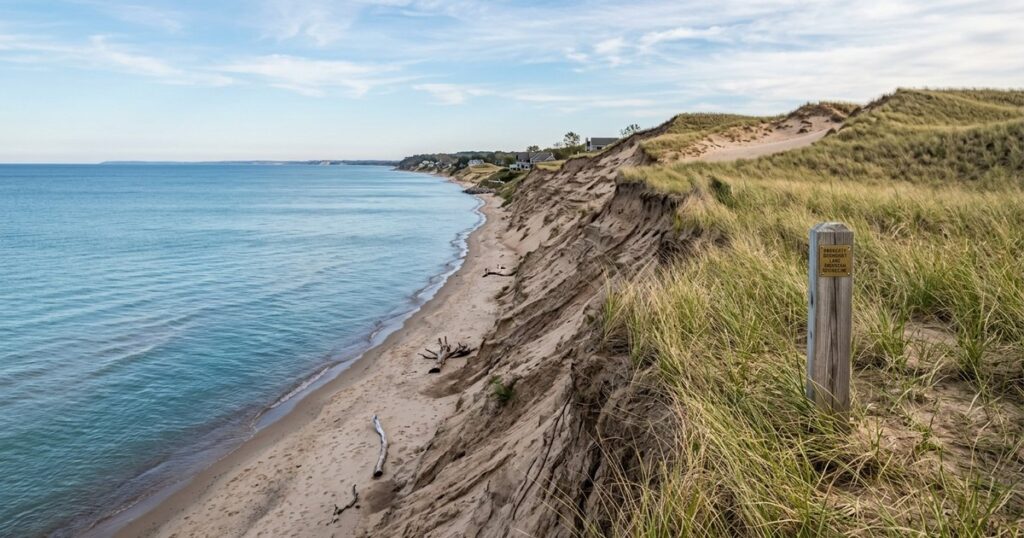
Frontage value on Lake Michigan does not follow a formula. It does not average out to something you can plug into a spreadsheet. It swings dramatically based on factors most buyers never think to ask about until it is too late.
A linear foot of shoreline that commands $40,000 on a wide, sandy, low-bluff beach might bring $5,000 on a high bluff with an eroded face. That is not a rounding error. It is an eight-to-one difference driven entirely by what the land actually does for its owner.
ABOUT THE EXPERT
Paul DeLano is the Broker and Owner of The Lake Life Realty Group. Known locally as the “Lake Guy,” Paul has over 30 years of combined experience in real estate, mortgage finance, and land development. Since 2012, he has been the #1 Inland Lake REALTOR® in Southwest Michigan, holding the highest market share for lakefront sales across Cass, Berrien, St. Joseph, Kalamazoo, and Van Buren counties. He focuses exclusively on buying and selling lake properties, tailoring the experience for local residents and second-home buyers from the greater Chicago and Indiana areas.
Beach Usability Is the Single Biggest Driver of Lake Michigan Frontage Value
The single biggest driver of Lake Michigan frontage value is whether you can actually use the beach. That sounds obvious, but many buyers see “lakefront” on the listing sheet and assume beach access comes with it. It does not always.
Some properties along the southwest shore lost their beaches during the intense erosion cycle that ran from 2015 to 2020. During that stretch, ice melt increased, lake levels rose, and storms pushed water into bluffs along the shoreline.
Some beaches simply disappeared. In many of those spots, stone revetments went in at $2,000 to $3,000 per linear foot to protect the bluff. Now the water laps right up to the rocks when conditions are rough. There is a shoreline, but there is no beach. The price reflects that difference.
As lake levels pull back, some of those beaches are re-emerging. Not all of them. If a property you are considering has a revetment wall between the home and the water, the first question you need answered is whether that beach has a realistic chance of coming back, and when.
Bluff Height Affects Lake Michigan Property Values
A low bluff with wide, flat, sandy access to the water is premium property. The lake is easy to reach, safe for guests who cannot comfortably navigate steep terrain, and accessible to all age groups. Those properties sit at the top of the Lake Michigan frontage pricing range.
A high bluff can be visually spectacular. It also introduces a completely different set of considerations. Expect steps down to the beach, erosion vulnerability at both the top and toe of the bluff, and stormwater drainage systems.
If the property sits within a high-risk erosion area (HREA), restrictions on what you can build, add, or modify apply as well. Those restrictions do not go away. They stay with the property and follow every future owner.
Understanding EGLE’s shoreline permitting requirements before you write an offer on a high-bluff property is essential.
Regulatory Constraints Are Already Priced Into Lake Michigan Properties
A seller with a property in an HREA or a critical dunes designation will not get the same per-foot value as a property without those overlays. But buyers who do not understand why a property is priced where it is can make costly mistakes. They might overpay on a constrained site because the view is stunning. Or they might pass on a well-priced property because they do not recognize that the restrictions are manageable.
Paul DeLano works the southwest shore from New Buffalo north through the St. Joseph area. He has advised buyers on the environmental, regulatory, and structural factors that set Lake Michigan properties apart. His depth of expertise in bluff dynamics, EGLE permitting, and HOA assessments comes from years of direct transaction work in these communities.
“You get your wide, low bluff, sandy beaches, and the price per front foot goes way up considerably. In my area, you’re seeing property values anywhere from $5,000 a front foot to $40,000 a front foot, depending on location and the height of the bluff, the beaches, and things like that. If you want to use your beach, there are some beaches that have stone revetments where the beach hasn’t come back, so the lake goes right up to those rocks. If it’s a windy day or there’s waves, that can be dangerous to go over the rocks to use the water.” – Paul DeLano, Broker and Owner
HOA Special Assessments Are Part of the Frontage Value Calculation
If you are purchasing in a homeowners’ association community along Lake Michigan, erosion costs may already be creeping into the financials. Special assessments for bluff protection and revetment installation have hit communities over the past decade.
Before you finalize any offer in an HOA community, request the reserve fund balance and look for pending assessments. A capital-improvements assessment of $1,700 per quarter, in addition to regular dues, is not unusual in some of these communities. It can run for years.
That number changes your carrying cost calculation. It changes your financing picture. And if you did not know how to ask for it, you will not see it coming until after closing.
Not sure what to look for in an HOA disclosure package before writing an offer? Reach out to the Lake Life Realty team before you get to that step.
Frontage Value Works Both Ways for Sellers
The per-foot value of your property depends almost entirely on three things. These are your beach condition, your bluff profile, and whether your property carries environmental or regulatory constraints.
A number you heard from a neighbor or saw on a listing down the road may apply to a completely different asset class. Even properties on the same stretch of shoreline can sit in different pricing tiers.
Lake Michigan is not one market. It is a series of micro-markets defined by bluff elevation, beach quality, erosion history, and regulatory overlay. Every one of those variables moves the number.
If you want to understand how those variables interact with your property, read about our home valuation process. It starts with frontage condition rather than square footage. That is a different approach than what most sellers encounter. It is also the right approach for this market.
Answers to Common Questions
What is the price per front foot on Lake Michigan in Southwest Michigan?
Frontage values on Lake Michigan in Southwest Michigan range from approximately $5,000 to $40,000 per linear foot of shoreline. The spread is driven by bluff height, beach usability, erosion history, and regulatory designations. Properties with wide, sandy, low-bluff beaches sit at the top of the range. Properties with high bluffs, eroded faces, or revetment walls with no beach fall toward the lower end.
Why does bluff height affect Lake Michigan property values so much?
Bluff height determines how easily you can access the water and how vulnerable the property is to erosion. Low-bluff properties offer flat, direct beach access and carry fewer regulatory restrictions. High-bluff properties often require steps to reach the water. They also face greater erosion risk at the bluff face and base, and may sit within HREAs designated by EGLE. Those designations limit future construction and modification.
What is a stone revetment, and how does it affect frontage value?
A stone revetment is an engineered wall of rock installed along the base of a bluff to slow erosion. Revetments typically run $2,000 to $3,000 per linear foot to install. While they protect the bluff, they often eliminate the beach because wave energy hits the rock wall instead of a sand face. Properties with revetments and no recoverable beach trade at significantly lower per-foot values than properties with open sandy frontage.
Should I worry about HOA special assessments when buying a Lake Michigan property?
Yes. Erosion-related capital improvements have triggered significant special assessments in many Lake Michigan HOA communities over the past decade. Before closing on any HOA property, request a full financial disclosure, including reserve fund balances and any pending or anticipated assessments.
Can national listing sites accurately estimate Lake Michigan frontage value?
No. Automated valuation tools cannot account for the variables that drive Lake Michigan frontage pricing. Key factors include bluff height, beach usability, revetment presence, EGLE designations, HOA assessment exposure, or erosion history. These factors require on-the-ground knowledge of specific shoreline segments. There is a reason automated estimates consistently miss on lake property, and it comes down to local variables.
What should I ask before making an offer on a Lake Michigan property?
Before writing an offer, you need answers to at least five questions:
- Is the beach currently usable?
- Has a revetment been installed, and has any beach re-emerged?
- Does the property carry a High Risk Erosion Area or Critical Dunes designation?
- If there is an HOA, what are the reserve balances and pending assessments?
- How has the bluff condition changed in the past ten years?
The answers determine whether the asking price is fair, aggressive, or a problem waiting to happen.
Value Lives at the Shoreline
Lake Michigan frontage is not a simple number you can compare across listings. The shoreline, the bluff, and the beach determine how valuable that frontage really is. Buyers who understand that difference avoid costly mistakes.
The Lake Life team works with lake property buyers across Southwest Michigan. We help clients separate surface appeal from real value before they commit. Reach out now to start your search.
Paul DeLano is the founder of The Lake Life Realty Group. He brings over 30 years of combined experience in real estate, mortgage finance, and land development, and has closed more than 1,069 Michigan lake property sales since 2012. His multi-disciplinary background spans surveying, engineering, financial advising, and land development, applied exclusively to Southwest Michigan lake properties.
*Information based on Lake Michigan waterfront and lake access provided by the Southwest Michigan Association of Realtors based on sales from Stateline to South Haven.