
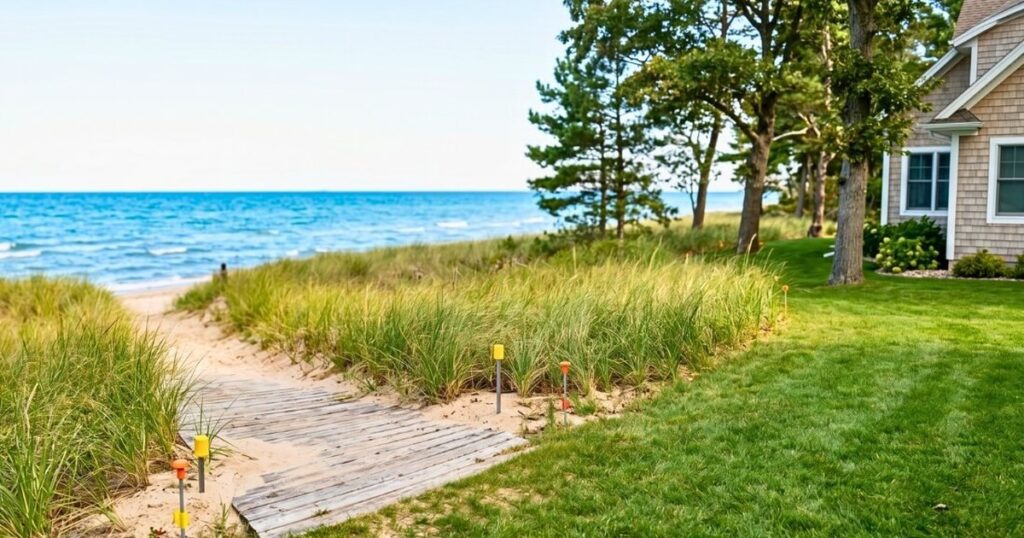
Most buyers shopping for a Lake Michigan property picture themselves stepping off the deck and onto the sand. What they do not realize is that the legal relationship between the home and that beach varies dramatically from one property to the next.
That difference shows up in price, in what you can build, and in what your neighbors may have rights to on your land. That is not a minor distinction. It is the foundation of every smart decision about purchasing a Lake Michigan home.
ABOUT THE EXPERT
Paul DeLano | Broker and Owner | Lake Life Realty | Known locally as the “Lake Guy,” Paul has over 30 years of combined experience in real estate, mortgage finance, and land development. Since 2012, he has been the #1 Inland Lake REALTOR® in Southwest Michigan, holding the highest market share for lakefront sales across Cass, Berrien, St. Joseph, Kalamazoo, and Van Buren counties. He focuses exclusively on buying and selling lake properties, tailoring the experience for local residents and second-home buyers from the greater Chicago and Indiana areas.
Beach Ownership on Lake Michigan Is Not Always What the Listing Implies
When you own a Lake Michigan property where your parcel extends all the way to the water, you hold full water ownership. Other people can walk the shoreline under Michigan’s public trust doctrine, but the beach itself is yours. That distinction matters, and the market prices it accordingly.
In Southwest Michigan, frontage values on Lake Michigan range from $5,000 per front foot to $40,000 per front foot. That spread is not just about location. It reflects bluff height, mucky or sandy frontage, and whether the property actually touches the water or relies on shared or association access.
In some communities, including the villages of Michiana and Grand Beach Village, the beach between the homes and the water is owned by the village. Residents can use it, but no individual property owner holds title to that frontage. In some neighborhoods, that barely affects value. In others, it is a meaningful distinction worth understanding before you fall in love with a listing.
Then there are easements. In older cottage communities along the southwest shore, former estates and resorts were subdivided over generations. That history created layered easement rights that still attach to the land today.
Even if you purchase a true lakefront property, neighboring parcels may hold a recorded easement. It could grant them a walking path across your beach, rights to use a designated strip of your shoreline, or access for enjoyment purposes.
Second-Row Properties Do Not Automatically Come With Beach Access
A significant share of buyers purchasing a property one or two rows back from the lake assume water access rights come with the purchase. Sometimes they do. Sometimes they do not.
Drew Vinton is a Lake Michigan property specialist with extensive experience across the southwest shore communities of Berrien County. He has worked the shoreline from New Buffalo north through Tagger and Covert Townships.
“Do I have lake access? Can you provide proof, a recorded deed, or any sort of easement access to the lake? Because a lot of times, people may think they have it, but they really don’t. It could be private beach that you don’t have access to. If you’re even an eighth of a mile from the beach, that’s the question to ask.” – Drew Vinton, Lake Michigan Specialist, Lake Life Realty
If the seller or listing agent cannot produce a recorded document, a deed, or a properly recorded easement, the access is not guaranteed. Verbal representations do not create legal rights. No amount of goodwill from the current owner changes what the next one is obligated to honor.
EGLE Designations Determine What You Can Build and Where
Lake Michigan’s shoreline is not static. Between 2015 and 2020, the lake reached levels that stripped beaches from shore properties. In some locations, those beaches returned as water levels receded. In others, they have not.
Michigan’s Department of Environment, Great Lakes, and Energy (EGLE) designates high-risk erosion areas along the shoreline. Properties in those zones are subject to setback requirements that govern what can be built, added to, or improved.
A home within a 30-year setback cannot build additions toward the lake. New construction in those zones often requires a movable foundation rather than a slab. That’s because the bluff could eventually erode to the point that a home would need to be relocated on the property.
Seawalls and stone revetments installed along the southwest shore during peak demand ran $2,000 to $3,000 per linear foot. Homeowners’ associations in affected communities levied special assessments across all owners to fund bluff protection on shared areas.
Ask for HOA financials before closing. Look at reserves. Find out whether any assessments are ongoing or anticipated.
Critical dunes designations add another layer. Driveway construction, vegetation removal, decks, and building envelopes are all subject to review. Vacant land that looks expansive on paper can have a single buildable envelope once the environmental constraints are mapped.
Property Taxes Reset When Ownership Transfers
Michigan caps annual property tax increases while a property remains with the same owner. When ownership transfers, that cap lifts. The new taxable value resets to the state equalized value, which is generally 50 percent of the market value under Michigan’s Proposal A. On a property held by one owner for 30 years, the difference can be dramatic.
Run the math before you fall in love with a specific property. At Lake Life Realty, we run a property tax estimate early in the process for every buyer so there are no surprises at the closing table.
Michigan residents who homestead a property also pay approximately 40 percent less in property taxes than non-residents. That is a variable that matters for out-of-state buyers weighing the true cost of ownership.
Questions Buyers Ask About Lake Michigan Water Access Rights
Does my Lake Michigan property include the beach below the bluff?
It depends on how the parcel is defined in the deed. When your property boundary extends to the water’s edge, you own the beach. However, the public retains the right to walk the shoreline below the ordinary high-water mark. In some village communities, the beach is owned by the village. Always review the deed and a current survey before assuming beach ownership.
What is a water access easement, and how do I confirm one exists?
A water access easement is a recorded legal right granted to one property owner to use a portion of another property. It’s typically a path to the beach or a designated strip of shoreline. To confirm an easement exists and is enforceable, you need a recorded document. It could be a deed that references the easement or a separately recorded easement agreement. Verbal assurances from a seller or listing agent are not legally binding and do not transfer with the property.
What are EGLE setback requirements, and do they affect existing homes?
EGLE designates high-risk erosion areas along Lake Michigan’s shoreline and establishes setback zones. These requirements restrict what can be built or added within those boundaries. Existing homes inside a setback zone generally cannot add lake-facing additions. New construction in these zones often requires a movable or relocatable foundation. Any planned improvements to a Lake Michigan property should be reviewed against current EGLE setback designations before purchase.
Can I build on a vacant Lake Michigan lot with a critical dunes designation?
Possibly, but the buildable area may be far smaller than the parcel size suggests. EGLE reviews and permits nearly every type of improvement in designated critical dune areas. In some cases, the cost of complying with access and construction requirements on a dunes parcel can reach seven figures. Have an environmental review completed on any vacant lakeshore parcel before making an offer.
How much can property taxes increase when I purchase a Lake Michigan home?
Michigan’s Proposal A caps annual property tax increases for existing owners, but the cap lifts upon a change of ownership. The taxable value resets toward the state equalized value, generally 50 percent of the assessed market value. Out-of-state buyers who do not use the property as a primary residence also pay a higher millage rate than Michigan residents who do.
How does village beach ownership affect property value in communities like Michiana or Grand Beach?
Village-owned beach means no individual homeowner holds title to the frontage between the home and the water. Residents still have access and use rights, but ownership remains with the village. In some communities, this distinction has little effect on market value. In others, the gap between village-access and fee-simple water ownership is measurable. Understand what you are buying before comparing prices across different community types.
Know the Details That Define Ownership
Every Lake Michigan property comes with rules that affect how you use it. Ownership, access, and regulatory limits all shape the experience after closing. Buyers who verify those details early make better decisions.
The Lake Life team guides buyers through these details before they write an offer. We work to uncover risks and confirm rights that listings often leave out. Reach out to start your search with the information you need.
Paul DeLano is the founder of The Lake Life Realty Group at The Lake Life Realty Group. He brings over 30 years of combined experience in real estate, mortgage finance, land development, surveying, and engineering, with 1,069 Michigan lake property sales closed since 2012. He holds the highest market share for inland lakefront sales in Southwest Michigan and carries a 5.0-star Zillow rating.
¹ Information based on inland lake sale information provided by Southwestern Michigan Association of REALTORS® based on inland lake sales in Cass, Berrien, St. Joseph, and the southern half of Kalamazoo and Van Buren counties.