
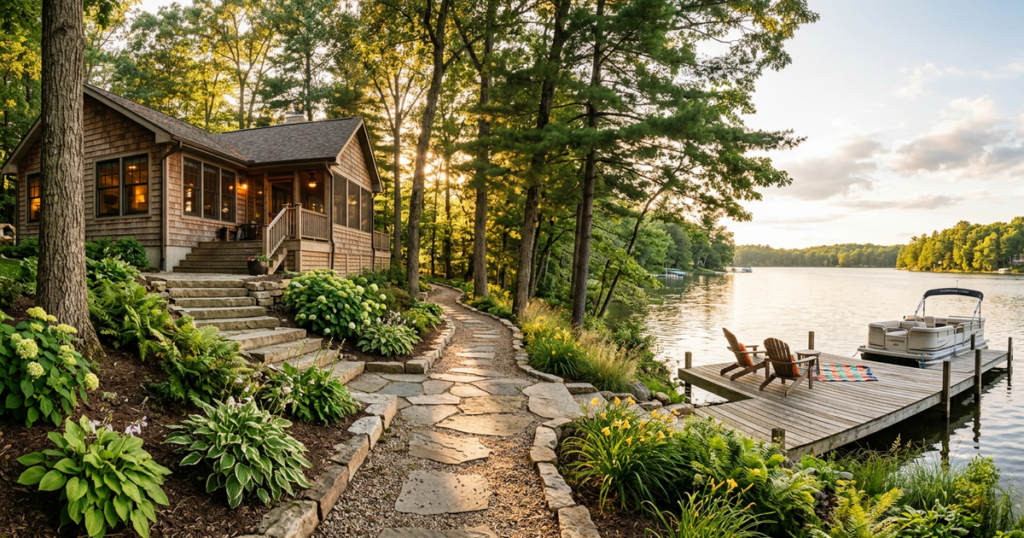
The time it takes to open the front door of a listing and enter a lake home makes more buying decisions in the Michigan lake home market than people realize.
It’s more than kitchens, bathrooms, square footage, and lake access combined.
Buyers don’t consciously evaluate what they see in first impressions; they feel it. And that feeling follows them all the way back to the car, long after they’ve forgotten the granite countertops.
Paul DeLano | Founder and Principal Broker & Owner, Lake Life Realty | #1 Lake Broker in Southwest Michigan since 2019 | 1,069+ Michigan lake property transactions closed
I have watched this happen on hundreds of showings across Michigan lake homes. Buyers walk through the house, nod politely at the kitchen, glance at the square footage, and then step outside toward the water.
What happens in the next sixty seconds tells me more about whether this home will sell than anything else in the listing.
That is lake property buyer psychology in Michigan lake homes, and it shapes outcomes that sellers rarely anticipate.
What Buyers Are Evaluating When They Step Out the Back Door
When I talk to sellers about preparing a lake home for the market, they immediately focus on the kitchen and bathrooms. Those things matter, but they rarely decide a sale at this price point.
Think about what a buyer unconsciously processes the moment they step outside:
- Where do the kids run?
- Where do you stage towels and snacks before heading down?
- How many steps to the water, and are they safe to walk barefoot?
- Is there a flat landing midway where someone older can catch their breath?
- Can you carry a kayak down without risking your knees?
These are not luxury considerations. They are the operational logic of lake life.
What Micro-Frictions Are and Why They Kill Deals
Micro-frictions are the small, functional obstacles buyers encounter during a showing without consciously recognizing them:
- A slightly uneven step
- A path that narrows between two overgrown shrubs
- A railing that wobbles when you grab it
- A landing that doesn’t exist where one should
None of these will appear in a home inspection report as a deal-breaker. But each one registers in the body before it reaches the brain.
Sellers rarely perceive these frictions because they’ve lived with them for years. They’ve adapted. Their guests have adapted. But a buyer evaluates every step fresh, on the first walk, with no prior relationship to the property and no tolerance built up for its quirks.
The first walk is the only walk that matters for the emotional decision.
How the Multigenerational Buyer Changes the Equation
One of the most significant shifts in lake property buyer psychology I’ve seen is the rise of the multigenerational buyer. These buyers are not shopping for a summer cabin for two. They are buying a destination property for the entire family. That includes everyone from grandparents to young children. The lifestyle has to work for every generation simultaneously.
That changes everything about how a property needs to perform. If grandma cannot comfortably reach the water, the lifestyle is broken. If there is no safe path for small children to run to the dock without constant supervision, the experience becomes stressful.
Sellers almost never think about this. The grade is just the grade. They adapted to it decades ago. But the buyer evaluates that same grade through the lens of everyone they are planning to bring there.
Paul DeLano has held the #1 Lake Broker position in Michigan since 2019. His perspective on showing psychology comes from thousands of real moments on real docks across the region.
“The route to the water, every single time. Stairs, grade, safety, where you carry chairs and coolers. Those micro-frictions matter. If it’s a difficult, steep path to the lake, buyers feel that in their body during the showing. Especially for multigenerational buyers. If grandma can’t comfortably get to the lake, the lifestyle breaks. Joyful sells. Exhausting sits.”
— Paul DeLano, Founder and Principal Broker & Owner, Lake Life Realty
What Sellers Can Do to Fix the Path Before Listing
The good news is that most of these issues are fixable without a major renovation budget. Sellers typically don’t need to rebuild the path to the water. It needs to be cleared, considered, and staged.
Start by walking the path with fresh eyes. Pretend you’ve never been to this property. Where do you hesitate? Where does the ground feel uneven? Where does a railing belong that isn’t there? Where could a gravel path replace a worn dirt trail?
Then think about the staging opportunity. A clean, wide path with simple landscaping on either side tells a buyer the lake is easy to reach. A built-in bench halfway down says, “This is a comfortable property, not a demanding one.” Lighting from the house to the dock says, “People use this place in the evenings, and it works.”
None of that is expensive. All of it changes how buyers feel.
If the grade is genuinely steep and cannot be changed, the strategy shifts from how you fix it to how you market it. Certain buyer profiles will not care at all. Stairs do not deter the water-skier who grew up on a hilly Michigan lake. Knowing your likely buyer and marketing to their lifestyle honestly is always the right move.
Not sure how your path reads to a buyer walking it for the first time? Reach out to the Lake Life Realty team. A single walk-through conversation can save weeks of market time.
How Listing Copy Changes When You Understand This Psychology
Buyers trust what is specific. Vague language makes them assume the worst.
I try to convey what potential questions I may get as clearly as possible. This answers the questions a multigenerational buyer is silently asking before they ever schedule a showing.
A west-facing home tells a buyer something real: sunset entertaining. Sandy frontage tells them something real: kid-friendly swimming. A well-described path to the water tells them something real: grandparents can actually use it. These are the details that make a buyer stop scrolling and read the full description.
Paul DeLano and the Lake Life Realty team close ten times more lake properties than any competitor in Michigan. He watches every week, which listing details stop buyers mid-scroll and which ones cost sellers weeks of market time. The path’s usability consistently falls into both categories.
“Specificity is what we use. We don’t write poetry. We write useful truth. Those are the details that make a buyer stop scrolling and read the whole description. Buyers trust what’s concrete. The minute you get vague or flowery, you’ve lost them.”
— Paul DeLano, Founder and Principal Broker & Owner, Lake Life Realty
The National Association of Realtors® researches buyer behavior. It consistently shows that emotional connection to a property during the showing is the leading driver of offer decisions. In Michigan lake markets, that emotional connection lives at the water’s edge.
FAQs About Selling Lake Homes With a Path to the Water
Does the path to the water affect the sale price and days on market for lake properties in Southwest Michigan?
Yes, to some degree, and the effect is more direct than most sellers expect. A path that feels effortless during a showing creates the emotional confidence buyers need to move quickly and compete on price. In Michigan lake markets, friction at the water’s edge may extend days on market, but there are usually other factors at play as well.
What are the most common path-related issues sellers overlook before listing a lake home?
The most frequently missed issues are uneven or crumbling steps, missing or unstable railings, and paths that narrow or lose definition partway down. The absence of a midpoint landing on steeper grades and the lack of lighting can also be issues.
How much does it cost to improve a lake property’s path to the water?
Most path improvements fall in the low-to-moderate range and don’t require a contractor. Clearing overgrowth, adding gravel, installing a railing, and adding solar path lighting are all projects a motivated seller can complete in a weekend. For steeper grades requiring engineered stairs or retaining work, costs rise, but the return on that investment is typically strong.
How does the lot grade affect which buyers a lake home attracts?
Grade is one of the clearest filters in the lake buyer pool. A gentle, accessible grade attracts multigenerational buyers, buyers with mobility considerations, and families with young children. A steep grade with significant stairs attracts younger, more active buyers who are less focused on long-term accessibility.
Should sellers disclose path or grade challenges before showing the property?
Honest marketing is always the right approach. Buyers who self-select based on accurate information are far more likely to close. Buyers who feel surprised or misled by a grade they weren’t emotionally prepared for quickly withdraw from the property.
Can strong listing copy compensate for a difficult path to the water?
Partially, but not completely. Strong copy can attract the right buyer profile and set accurate expectations, which reduces disappointment during the showing. It cannot replicate what a buyer feels in their body when they walk an effortless path to the dock. The best outcome is always a property where the physical experience matches or exceeds the listing’s description.
How do multigenerational lake buyers approach showings differently?
Multigenerational buyers evaluate every physical element through multiple filters at once. They look at what works for a toddler, a teenager, and a grandparent. They move more slowly through showings, ask more specific questions about grades and railings, and are more likely to make decisions based on accessibility than aesthetics. Properties that perform well for this buyer type communicate that performance through both the physical path and the listing language.
Is lot grade something a buyer can negotiate on price?
Grade is a permanent site condition, so the negotiation is built into the property is price relative to comparable lakefront listings. A steep grade that limits the buyer pool typically shows up in days on market and, eventually, in price. Sellers who understand the impact of their grade before listing can price strategically from the start, rather than absorbing market feedback through repeated price reductions.
Start With a Walk Before You Do Anything Else
Before you do anything, walk your property slowly. Walk it like someone who has never been there. Notice every step, every grade change, every place where a stranger might pause or hesitate.
That walk will tell you more about what your property needs than any punch list ever will.
Do you want a second set of eyes to evaluate the property? Paul DeLano has made that walk hundreds of times on lake properties across Southwest Michigan. Contact the Lake Life team to get started.
Paul DeLano is the Founder of Lake Life Realty at thelakelife.com. He has held the #1 Lake Broker position in Southwest Michigan since 2019 and brings nearly three decades of experience in land development, financial advising, and lake property marketing to every transaction.