
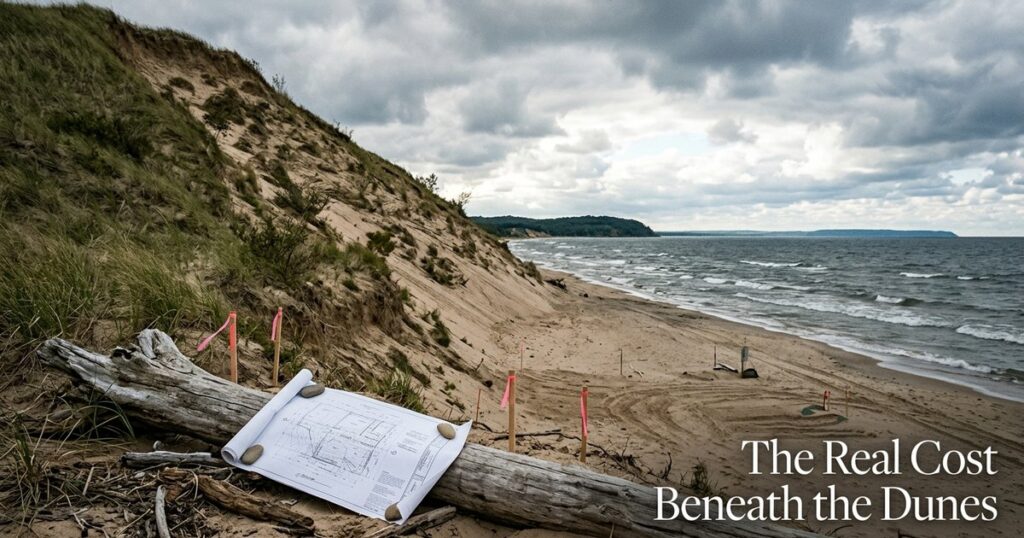
The critical dunes designation along the Lake Michigan shoreline is one of the most expensive variables a buyer can overlook. On certain parcels in Southwest Michigan, it can have a very real impact on ownership.
With this designation, the state environmental permitting authority might control what you can build and where you can build it. Before you fall in love with a bluff-top lot or a wide sandy beach, you need to know whether this designation applies.
ABOUT THE EXPERT
Paul DeLano is the Broker and Owner of The Lake Life Realty Group. Known locally as the “Lake Guy,” Paul has over 30 years of combined experience in real estate, mortgage finance, and land development. Since 2012, he has been the #1 Inland Lake REALTOR® in Southwest Michigan, holding the highest market share for lakefront sales across Cass, Berrien, St. Joseph, Kalamazoo, and Van Buren counties. He focuses exclusively on buying and selling lake properties, tailoring the experience for local residents and second-home buyers from the greater Chicago and Indiana areas.
Critical Dunes Designation Identifies Which Parcels EGLE Controls
A critical dunes designation identifies specific coastal areas along Lake Michigan that are protected under state-level environmental laws. Properties within these zones fall under the permitting authority of the Michigan Department of Environment, Great Lakes, and Energy (EGLE). They regulate construction, vegetation clearing, grading, driveway installation, tree removal, deck size, and site access improvements.
Not every Lake Michigan property falls within a critical dunes area. The designation shows up in pockets. You’ll find them south of New Buffalo, between Lakeside and Stevensville, and north through Tagger Township up into Covert Township. If your property sits in one of those zones, EGLE holds permitting authority over virtually everything you do on that land.
Here is where buyers get caught off guard. A parcel may look generous on paper: five acres, wide sandy frontage, stunning beach. However, it might still leave you with one buildable envelope and a site-access cost that rivals the land purchase itself. The footprint you are allowed to build within can be dramatically smaller than the total acreage. That’s because EGLE works to minimize disturbance to the dune system.
A Driveway on a Critical Dunes Parcel Can Cost as Much as the Land
Drew Vinton is a Lake Michigan specialist at Lake Life Realty. He worked on a consulting project involving this kind of property. It was five acres with 350 feet of sandy frontage. The site looked stunning, but the problem was the topography.
The only viable building envelope sat atop a bluff, with no road access. Getting there required cutting a driveway up through the dune. That meant working at a regulated width, at a regulated slope, and with protective stabilization measures on both sides of the cut.
What is the estimated cost to install that driveway? Approximately one million dollars.
That is not an outlier. It is what critical dunes permitting can do to a site analysis. And it is the kind of cost that never appears in a listing description.
Drew has worked extensively along the Lake Michigan shoreline. He has experience navigating EGLE permitting, erosion setbacks, and the layered regulatory environment that governs these properties.
“It was a five-acre piece of land with 350 feet of frontage on Lake Michigan, beautiful wide sandy beach, but the topography of the site was basically a hilltop. The person that bought the property would have to install a driveway somehow to get up to the building site on top of the bluff. Based on my conversation with other people involved, it was probably going to cost about a million dollars to put in. You can only do a certain width driveway, it has to be at a certain slope, and then you have to protect the driveway on each side because it’s basically dug into the dune going up to the home.” – Drew Vinton, Lake Life Realty
Additional Restrictions on a Critical Dunes Property
The driveway cost is the most dramatic example, but the critical dunes designation shapes the entire site. Decks face size limitations. Vegetation removal and tree clearing may require replanting with native species. The buildable envelope gets defined not just by setbacks but by topography and the presence of rare plants. Foundations require specific engineering to minimize the dune footprint.
When a high-risk erosion classification overlaps a critical dunes designation, the layers compound. Under EGLE’s coastal management framework, improvements must be set back from 30-year and 60-year erosion projections. Additions cannot extend toward the lake. In some new-build scenarios, the structure must be placed on a movable foundation so it can be relocated if the bluff erodes beneath it.
Buyers who understand the full picture going in can structure their due diligence and their negotiations around actual site costs rather than assumptions. That is a very different position from discovering these restrictions after you have already committed.
Key Points Buyers Should Know Before Making an Offer
When evaluating a Lake Michigan site, there are two key points you can’t miss.
The first is the environmental one. Understanding the parcel’s critical dunes designation and high-risk erosion status before making an offer is the single most overlooked factor in this market. Both pieces of information are available through EGLE before you write an offer.
A review of the parcel against EGLE’s coastal zone maps, combined with a site consultation, provides the clearest picture of what restrictions apply. Never rely on the listing description alone.
The second issue involves beach access. Not just whether a beach exists, but whether a recorded right to reach it exists. Association neighborhoods, village-owned shorelines, and easement-based access situations are common along this stretch of coast.
A buyer who assumes access without confirming it in writing can end up owning a property with no legal path to the water. What appears in a listing description does not create any legal rights. Only recorded documents do.
What to Check Before You Write an Offer on Lake Michigan Vacant Land
Buying vacant land on Lake Michigan with a critical dunes designation requires a different checklist than a standard residential purchase.
Start by confirming the EGLE designation for the parcel. Have a professional assess the buildable envelope and any site-access costs. Review erosion area classifications and required setbacks.
If the property sits within an HOA or a community association, pull the financials and check for any pending or recent special assessments. Special assessments tied to erosion and bluff work are among the most common costs buyers fail to budget for on Lake Michigan properties.
These are not obstacles to ownership. They are the full picture of what you are buying. Buyers who understand that picture before they make an offer can move forward with confidence.
Questions Buyers Ask About Critical Dunes on Lake Michigan
Does a critical dunes designation prevent me from building on my Lake Michigan property?
Not necessarily, but it restricts what you can build and where. EGLE determines the buildable envelope based on topography, vegetation, and proximity to the dune system. Permitted structures, driveways, and decks must meet specific size, slope, and mitigation requirements. In some cases, the buildable area is significantly smaller than the total parcel acreage.
How do I find out if a specific Lake Michigan parcel carries a critical dunes designation?
EGLE maintains mapping resources that identify critical dune areas across Michigan’s Lake Michigan shoreline. A review of the parcel against EGLE’s coastal zone maps, combined with a site consultation, provides the clearest picture. Never rely on the listing description alone for this determination. The EGLE coastal zone mapping system and county register of deeds are both useful starting points.
What does beach access actually mean on a Lake Michigan property?
Beach access refers to your legal right to reach the shoreline from your property. On Lake Michigan, this varies significantly by location. Some properties have direct frontage. Others depend on recorded easements, HOA-owned beach strips, or village-controlled shoreline access. Confirming the exact nature of your access rights in writing before purchase is essential.
Can an existing Lake Michigan home be expanded if it sits in a critical dunes zone?
Expansion is possible but subject to EGLE review and approval. Additions that extend toward the lake or increase dune disturbance face the most scrutiny. Setback requirements, footprint limitations, and vegetation replacement rules all apply. Any planned expansion should be evaluated against current EGLE standards before closing, not after.
What is the difference between a critical dunes designation and a high-risk erosion area on Lake Michigan?
These are two different classifications that can overlap on the same parcel. A critical dunes designation is tied to the ecological sensitivity of the dune system and triggers the EGLE permitting authority. A high-risk erosion area is a separate classification that identifies shorelines with documented bluff recession risk. When both apply, setback requirements and construction limitations compound. Structures may need to be built on movable foundations to allow relocation if the bluff recedes.
Know the Details Before You Commit
Lake Michigan land can hide major costs beneath its natural beauty. Buyers who investigate early avoid surprises that can reshape their entire investment.
The Lake Life Realty team brings decades of lake property experience to every client conversation. Reach out now to start a conversation. We can help you evaluate properties and assess environmental limitations.
Paul DeLano is the founder of The Lake Life Realty Group. With over 30 years of combined experience across real estate, mortgage finance, land development, and surveying, Paul has focused exclusively on Southwest Michigan lake properties since founding Lake Life Realty. He has been the #1 Inland Lake REALTOR® in Southwest Michigan since 2012, with the highest market share for lakefront sales across Cass, Berrien, St. Joseph, Kalamazoo, and Van Buren counties.
*Information based on Lake Michigan waterfront and lake access provided by the Southwest Michigan Association of Realtors based on sales from Stateline to South Haven.