
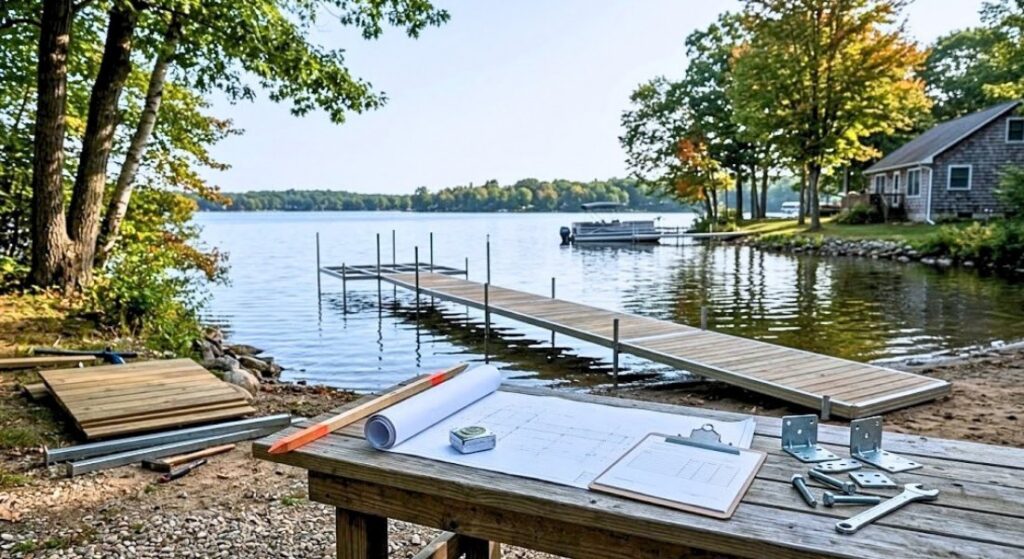
If you are coming from a coastal market or elsewhere in the country, you may assume dock installation requires permits and paperwork. Michigan generally exempts qualifying seasonal docks on inland lakes from state permitting requirements.
The exemption applies to seasonal docks used for private, noncommercial recreation and removed at the end of the boating season. Docks must also avoid unreasonable interference with others' use of the water or its natural flow.
Qualifying seasonal docks on Southwest Michigan inland lakes generally do not require state permits when they meet Michigan's conditions. Seasonal dock installation and removal create recurring costs for lakefront homeowners. Mucky frontage can often be improved through practical solutions. Buyers should also confirm what "dock included" means in a listing and budget for ongoing waterfront maintenance before closing.
Seasonal Dock Permit Rules in Michigan
The simplicity of dock installation in Southwest Michigan is one of those quiet advantages of this market that rarely appears in listing descriptions.
When I tell buyers that qualifying seasonal docks do not need state permits, the reaction is almost always the same. They pause and ask if the process really is that straightforward.
Under Michigan Department of Environment, Great Lakes, and Energy (EGLE) guidelines, qualifying seasonal private docks generally do not require state permits. The dock must be used for private, noncommercial recreation and cannot unreasonably interfere with others' use of the water or its natural flow. The exemption does not apply to docks placed in wetlands.
Permanent docks and boat hoists left in the water year-round generally require EGLE permits. A dock company can help explain the applicable process. For a standard seasonal dock, you typically call the company and schedule the installation. Property rights, association rules, and applicable local requirements should still be confirmed before installing a dock.
What "Dock Included" Means in a Lake Home Listing
When you see "dock included" in a lake home listing, the phrase does not always mean what you think it means.
Winter ice can damage docks left in the water, so seasonal removal is common in Southwest Michigan. Many properties have sectional docks, either floating or supported by steel pipes, that are removed each fall and reinstalled each spring.
Before making an offer, ask the seller or listing agent:
- What type of dock is included, and does it suit your intended use?
- What condition is the dock in? Will it need repairs or replacement sections?
- Who handles installation and removal, and what does the service cost annually?
- Is a boat lift included in the sale?
Dock installation and seasonal removal add recurring costs to lake home ownership. Depending on the dock's size and configuration, installation and removal could cost several hundred to a few thousand dollars per season. A boat lift can add to the annual cost. These expenses belong in your ownership budget from day one.
For more on what lake access listings actually promise, read Lake Access Listings Rarely Tell You What You Actually Get.
Mucky Lake Frontage and Improvement Options
Muck is a soft lake-bottom material made up of fine sediment and decomposing organic matter. Wind patterns, currents, and location influence whether lake frontage is sandy or mucky.
Mucky frontage can often be improved, but the right approach depends on the lake bottom, water depth, and intended use.
Paul DeLano has spent nearly three decades specializing in Southwest Michigan inland lakes. During a showing at a $2.9 million property, a buyer wanted the mucky bottom improved immediately. He described several possible solutions:
"There's a weed roller that rolls across the bottom that loosens up all the silt, and it blows away. You can also buy a blower that pumps 1,200 gallons a minute and will blow the muck out. If you're looking to clear a 20 by 30 section, you probably could spend $10,000 on a weed roller or $8,000 on a blower. And if you did Beach in a Day, it might cost $10 or $11,000 now."
— Paul DeLano, Broker / Owner, Lake Life Realty
Removing substantial amounts of muck can take six months to a year. Mucky frontage may be manageable, but improvements take time and may not deliver the conditions buyers want. Buyers should consider how they plan to use the water before deciding whether improvements are worthwhile.
Before starting work, buyers should confirm the method's suitability and any required permits. EGLE regulates weed rollers, lake-bottom alterations, and underwater sand placement. Requirements depend on the proposed work.
Budgeting for Waterfront Maintenance
Beyond the purchase price, lake homeowners should budget for recurring waterfront expenses and potential improvements.
Seasonal dock installation and removal can cost several hundred to a few thousand dollars per season, depending on size and configuration. A quote from a local dock company helps establish a more accurate budget.
Boat lift installation and removal is a separate expense that depends on the equipment and service requirements. If the listing includes a lift, ask for a current service quote before finalizing your purchase numbers.
Frontage improvements can add high costs, depending on the lake bottom and your intended activities. As discussed above, solutions range from weed rollers and blowers to professional beach installations. Confirm current prices and permit requirements before starting work.
Other waterfront expenses can include pontoon storage, kayak racks, water toys, and seasonal winterization of waterfront plumbing.
Understanding these costs helps buyers plan for ownership beyond the purchase price.
For guidance on budgeting for a specific property, contact the Lake Life Realty team before making an offer.
Dock Condition and Shared Lake Access
Beyond installation costs, buyers should check dock condition and understand any restrictions tied to shared lake access.
Dock hardware naturally wears over time, particularly when sections are installed and removed each season. Sectional aluminum or steel-pipe docks used for ten or fifteen seasons may need repairs or replacement parts. Ask the seller about the dock's age and any recent repairs or replacements.
Some properties offer shared lake access through a property owners association rather than direct lake frontage. Association rules and recorded documents determine which waterfront activities are allowed and whether dock installation is permitted. Review the association covenants and recorded access rights before assuming you can install a dock.
The Southwestern Michigan Association of REALTORS® MLS provides useful listing information. Buyers should still review recorded documents and verify the property's actual frontage conditions. An experienced buyer's agent can help identify relevant documents and questions for title professionals or an attorney.
Common Questions About Southwest Michigan Lake Docks
Do you need a permit to install a dock in Southwest Michigan?
Qualifying seasonal docks on inland lakes generally do not require state permits if they serve private, noncommercial recreation and meet EGLE's conditions. They cannot unreasonably interfere with other water users or water flow, and they cannot be placed in wetlands under this exemption. Permanent docks and boat hoists left in the water year-round generally require permits. Property rights, association rules, and local requirements may also apply.
Why do docks come out every winter in Southwest Michigan?
Freezing and shifting ice can damage docks, so many homeowners remove their seasonal docks each fall. They arrange installation again in spring, making removal and reinstallation recurring ownership expenses.
What does "dock included" mean in a lake home listing?
The phrase generally means the dock hardware is included in the sale, but buyers should confirm the details. Ask about its type, age, condition, and installation status, along with annual service costs. Buyers should also verify their legal dock rights through recorded property documents. The article MLS Listings Don't Guarantee Dock or Lake Rights explains these considerations in greater detail.
Is mucky lake frontage common in Southwest Michigan?
Mucky frontage occurs on Southwest Michigan inland lakes, but conditions vary by location. Wind patterns, currents, sediment, and decomposing organic matter can affect the lake bottom. Mucky frontage does not automatically make a property unsuitable for a buyer's intended activities.
Can mucky lake frontage be improved or cleared?
Several methods may improve mucky frontage, depending on the lake bottom and intended use. Paul DeLano estimates a weed roller could cost around $10,000, a blower around $8,000, and a Beach in a Day installation around $10,000 to $11,000. Results vary by location, and some methods require permits. Buyers should assess local conditions and confirm current costs before committing to improvements.
What does seasonal dock maintenance cost annually in Southwest Michigan?
Installation and removal for a standard sectional dock can cost several hundred to a few thousand dollars per season. Pricing depends on dock size, configuration, location, and included services. Boat lift installation and removal may add to the annual expense.
What should I ask a dock company before buying a lake home?
Request a current installation and removal quote for the specific dock included in the listing. Ask about its condition, age, replacement parts, and likely maintenance needs. If a boat lift is included, confirm its condition and seasonal service costs. A dock company may also be able to inspect the equipment and estimate repair costs before closing.
Does EGLE regulate any waterfront activity on inland lakes?
Yes. EGLE regulates activities such as dredging, filling, and certain construction on inland lakes. Qualifying seasonal docks may be exempt from state permitting, while weed rollers used to manage aquatic weeds and sand placement below the water line require permits. Buyers should confirm applicable requirements before starting waterfront improvements.
Get the Full Waterfront Picture Before Buying
Buying a lake home involves more than evaluating the property and its view. Most buyers spend weeks on square footage and kitchen finishes before they test the water. Dock condition, seasonal costs, access rights, and shoreline conditions can all affect your ownership experience.
Qualifying seasonal docks may be exempt from state permits, but buyers still need to understand property restrictions and ongoing costs. If the frontage has muck, potential improvements are also worth evaluating before making an offer.
These details can be difficult to assess from a listing alone. If you are considering lake properties in Southwest Michigan, contact the Lake Life Realty to discuss what to look for before buying.
Information based on Southwest Michigan inland lakes provided by the Southwestern Michigan Association of REALTORS® based on sales from Cass, Berrien, St. Joseph, and the southern half of Kalamazoo and Van Buren counties.
ABOUT THE AUTHOR
Paul DeLano is the Broker and Owner of Lake Life Realty. Known locally as the "Lake Guy," Paul has over 30 years of combined experience in real estate, mortgage finance, and land development. Since 2012, he has been the #1 Inland Lake REALTOR® in Southwest Michigan, holding the highest market share for lakefront sales across Cass, Berrien, St. Joseph, Kalamazoo, and Van Buren counties. He focuses exclusively on buying and selling lake properties, tailoring the experience for locals and second-home buyers from the greater Chicago and Indiana areas.