
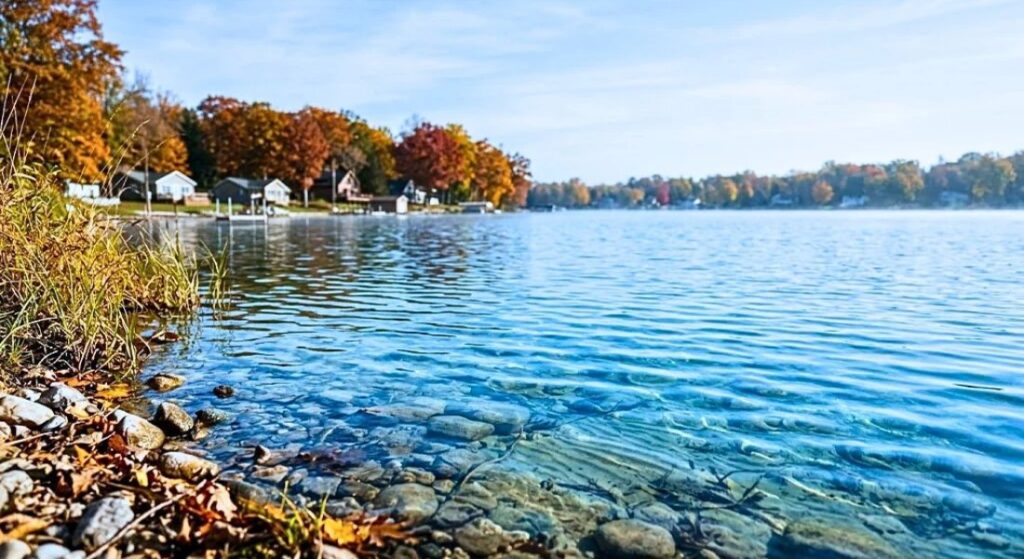
Most buyers shopping for a Southwest Michigan lake home have a list that includes sandy frontage, a good dock, and room for the boat. What almost nobody puts on that list is a water source. It may be one of the most important factors in how much you'll love the lake you buy.
Spring-fed lakes give owners a baseline water quality that has nothing to do with timing, maintenance, or the neighbor's lawn care routine. In Southwest Michigan, that advantage comes built into the landscape.
Southwest Michigan's inland lakes are predominantly spring-fed, giving them naturally cleaner, clearer water than the watershed lakes common in Indiana and Wisconsin. That difference affects water color, clarity, and long-term lake health. Knowing how to evaluate what you're seeing on a showing day protects you from making the wrong call on a purchase.
Understanding Spring-Fed Lakes
A spring-fed lake is replenished by underground springs pushing up through the lake bed. That means consistent, cold, clean water with relatively stable clarity year-round.
A watershed lake collects surface runoff: rain, irrigation, agricultural drainage, and whatever flows in from the surrounding land. That water carries sediment, nutrients, and conditions that can make water murky, greenish, or prone to algae over time.
Watershed lakes are common in Indiana and Wisconsin, while the majority of Southwest Michigan's inland lakes are spring-fed. That distinction directly affects water color, how deep you can see on a calm morning, and the lake's long-term health. For buyers comparing multiple lake markets, this geological difference shifts the math significantly in Southwest Michigan's favor.
What Makes Southwest Michigan Lakes Stand Out
Few buyers walking into a Southwest Michigan lake search realize they are starting with a geographic advantage. The spring-fed character of these lakes is simply how the region's geology works, so it is baked into the landscape.
"In Southwest Michigan, we are very fortunate to have mostly spring-fed lakes, which are higher quality and clarity than a watershed. Whereas Indiana and Wisconsin tend to be watershed lakes. And so there's a definite difference in the color of the lake and the clarity of the lake." – Paul DeLano, Broker and Owner, Lake Life Realty
That difference becomes immediately visible once you've stood at the edge of both kinds of lakes. The color of the water and how far you can see into it are where it shows up first. Buyers tend to notice it on their own, without anyone pointing it out.
Water Clarity and Water Quality Are Not the Same Thing
This distinction is worth making because buyers often mix them up during showings. Water quality refers to what's actually in the water: chemical composition, bacteria levels, and nutrient load. Water clarity refers to how deep you can see into the lake.
A lake can have excellent water quality and temporarily low clarity on a busy summer weekend. That temporary drop comes from simple physics, as boats stir up sediment from the bottom.
This misread is something we see buyers make often when they tour homes. Some buyers arrive on a holiday weekend, see a hundred boats churning the surface, and walk away worried about the lake. What they are reacting to is prop wash and sediment kick-up, which says little about the actual condition of the lake.
"I have been on showings where the buyers are concerned because there was a Fourth of July and there's a hundred boats out and the water clarity is awful. All that typically is is just sediment kick-up from boat prop, especially when you're dealing with either wind or a Fourth of July weekend." – Matt DeLano, Buyer Specialist, Lake Life Realty
The lake itself hasn't changed, and only the conditions on that one afternoon have. Wind and heavy boat traffic can cloud the water for a day or two before it settles again. Understanding that difference keeps buyers from walking away from a lake they would have loved.
Not sure how to read what you're seeing on a showing day? Our team at Lake Life Realty can walk you through it. That conversation is worth having before you rule out a lake based on one visit.
Spring and Fall Give the Clearest Picture of a Lake
Spring and fall give you the clearest picture of what a lake actually is. Boat traffic is gone, the water has settled, and what you're looking at is as close to baseline as it gets. A lake that looks beautiful in November or April is giving you a meaningful impression.
Summer holiday weekends are the worst time to judge clarity. Every boat on the water stirs up the bottom, and prop wash does the rest. A single Fourth of July showing tells you almost nothing about how that lake looks on a Tuesday morning in September.
Look at a lake more than once and in more than one season when you can, especially if you are evaluating it seriously. The difference between a great showing day and an average one on a spring-fed lake is minimal. That swing can be dramatic on a watershed lake, where runoff can cloud the water after every heavy rain.
How to Research Spring-Fed Lake Water Quality Before You Offer
You don't have to rely only on what you see during a showing. Several resources can give you a broader picture of a lake's history and water conditions. Many lake associations conduct regular water clarity testing and publish the results. Ask for that data if the lake you're considering has an active association. That data tells the story of a lake across several seasons.
The Michigan Department of Environment, Great Lakes, and Energy (EGLE) maintains water quality data across the state. Looking up reports on a lake you're seriously considering takes about twenty minutes and can tell you far more than any single visit. EGLE's monitoring data covers nutrient levels, bacteria counts, and historical clarity trends for many of Southwest Michigan's most active lake markets.
That research, combined with what you see in person during the right season, gives you a much more complete picture of what you're actually buying. The EPA's National Aquatic Resource Surveys provide lake health benchmarks that add context when you compare local conditions to broader water quality standards.
Buyers who do that work before writing an offer tend to feel much more confident at the closing table. Water quality is also one of the lake home details you won't find in a listing description.
FAQs About Spring-Fed Lakes in Southwest Michigan
What is a spring-fed lake, and why does it matter to buyers?
A spring-fed lake is replenished by underground springs rather than surface runoff. The result is consistently cleaner, clearer water that is less susceptible to algae blooms and nutrient-driven cloudiness. For buyers, it means higher baseline water quality built into the lake itself. That baseline does not depend on how well neighbors manage their shoreline.
Are most Southwest Michigan inland lakes spring-fed?
Yes, the majority of Southwest Michigan's inland lakes are spring-fed, which distinguishes the region from Indiana and Wisconsin, where watershed lakes are more common. That regional advantage is a meaningful factor for buyers comparing multiple lake markets at the same time. Many of those buyers come from the Chicago and Indiana areas, so they can compare the difference firsthand.
What is the difference between water clarity and water quality?
Water clarity is how far you can see into the water. Water quality is what is actually in the water: nutrient levels, bacteria, and chemical composition. A lake can have strong water quality and temporarily reduced clarity on a busy weekend because boat traffic stirs up bottom sediment. The two measures are related, but they track different things about a lake.
How can I research spring-fed lake water quality before making an offer?
Two good starting points are the lake association, if the lake has one, and the Michigan Department of Environment, Great Lakes, and Energy (EGLE). Many lake associations publish the results of regular water testing. EGLE maintains water quality data for specific lakes across the state. Both sources provide historical context that a single showing day cannot. Beyond clarity and quality, there are other points to test about lake water before making an offer.
Does murky water during a showing mean the lake has a water quality problem?
Murky water during a showing does not necessarily mean the lake has a water quality problem. On busy weekends or windy days, sediment stirred up by boat propellers can significantly reduce visibility. That cloudiness typically clears within a day or two once the water settles. A single murky showing on a spring-fed lake with a history of strong clarity is usually just a timing issue.
Does a lake's water clarity affect its resale value over time?
Water clarity is one of the factors buyers evaluate when comparing lakes. Spring-fed lakes with consistently clear water tend to hold buyer demand well over time. Lakes with known water quality problems face a narrower buyer pool, which affects both pricing and days on market. The Michigan Lakes and Streams Association notes that poor water quality can reduce inland lake shoreline property values by as much as 40%. Clarity is one of several value drivers, and it shows up consistently in how buyers rank their options.
What other factors affect water quality on a Southwest Michigan lake?
Shoreline development, agricultural runoff, boat traffic patterns, and the lake association's activity level all play a role. A spring-fed source gives a lake a strong foundation, but how the surrounding watershed is managed still matters. Lakes with active associations that monitor clarity and restrict certain activities tend to maintain their water quality more consistently across seasons. Frontage is another value driver beneath the surface, and buyers should know whether mucky frontage is a dealbreaker on Southwest Michigan inland lakes.
Can a lake be spring-fed and still have water quality problems?
Yes, a spring-fed lake can still have water quality problems. A spring-fed source improves a lake's baseline, but it does not make a lake immune to problems. Heavy shoreline development, failing septic systems, or heavy agricultural runoff from the watershed can degrade water quality even in spring-fed lakes. The spring-fed classification is a strong starting advantage, but it doesn't guarantee clean water. EGLE monitoring data and lake association records help buyers verify what a classification alone cannot confirm.
Evaluate Your Next Lake With Lake Life Realty
Wondering whether the lake you toured looked like itself on showing day? Southwest Michigan's spring-fed lakes have an advantage, and understanding that advantage helps you judge a lake fairly in any season. Start the conversation with Lake Life Realty to understand what you are buying beneath the surface.
Information based on Southwest Michigan inland lakes provided by the Southwestern Michigan Association of REALTORS® based on sales from Cass, Berrien, St. Joseph, and the southern half of Kalamazoo and Van Buren counties.
ABOUT THE AUTHOR
Paul DeLano is the Broker and Owner of Lake Life Realty. Known locally as the "Lake Guy," Paul has over 30 years of combined experience in real estate, mortgage finance, and land development. Since 2012, he has been the #1 Inland Lake REALTOR® in Southwest Michigan, holding the highest market share for lakefront sales across Cass, Berrien, St. Joseph, Kalamazoo, and Van Buren counties. He focuses exclusively on buying and selling lake properties, tailoring the experience for local residents and second-home buyers from the greater Chicago and Indiana areas.